
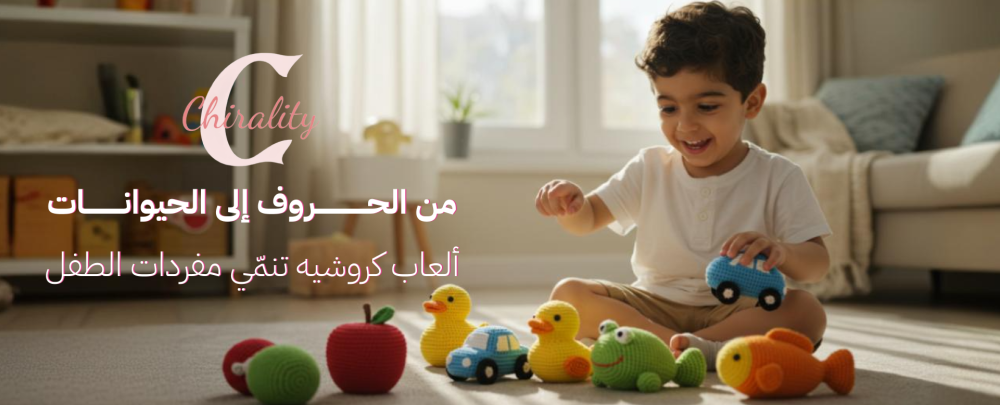
Early childhood is a crucial period for building a child's linguistic and cognitive foundation, as they begin to acquire communication and language skills that directly impact their educational and social development. In this context, crocheted toys for children stand out as an innovative educational tool that combines fun and learning. More than just hand-crocheted items, they become effective tools that help develop a child's vocabulary and enhance their language abilities. With their unique designs featuring letters, numbers, and animals, these toys offer a sensory learning experience that stimulates imagination and develops speech and expression skills in young children.
Why are educational crochet games useful?
High safety and tangible quality
These toys are made from natural threads, making them soft, safe, and chemical-free, ensuring their safe use from the age of 6 months.
Visual and verbal association of letters and words
Crocheted letter-shaped toys, such as the letter 'B' with a duck attached, help children connect the written form with the correct pronunciation of the word, as well as recognize the object itself, thus enhancing phonological and linguistic awareness in early developmental stages. This idea supports the recommendations of the International Literacy Association , which emphasizes the importance of developing basic reading and writing skills from a young age.
Emergent Literacy is supported by leading educational resources.
According to the International Literacy Association (ILA) and the concept of early literacy, early recognition of letters through touch and recognition through stories enhances a child's ability to connect words and sounds.
Learning through sensory and motor play
According to the principles of NAEYC (National Association for Early Childhood Education) , the use of hand-knitted stuffed toys provides a multi-sensory experience, developing vocabulary, expression, and memory.
This letter, that duck: Learning letters in a visual way
Crocheted letter-shaped toys, whether in Arabic or English, enable children to see the letter, learn its name and pronunciation, and connect it to a visual object such as a number or a physical object (like the letter ج with a sentence). This contextual connection enhances a child's thinking and prepares them for future reading and writing.
Building vocabulary:
When a child sees the letter 'B' in the shape of a duck, they learn: B, duck, the sound of 'B', the color of the duck and possibly its sound, which expands their vocabulary in a fun way.
Knitted animals: expanding vocabulary and communication
By using crocheted animal shapes such as a cat, rabbit or elephant, the child enhances their understanding of objects, forms imaginary friendships, and develops the recall of words such as cat and elephant and their association with colors and sounds.
Sensory learning through play:
Playing with tangible characters (soft knitted animals) is one of the most effective ways to establish vocabulary in children, according to the NAEYC principles of sensory learning in early childhood.
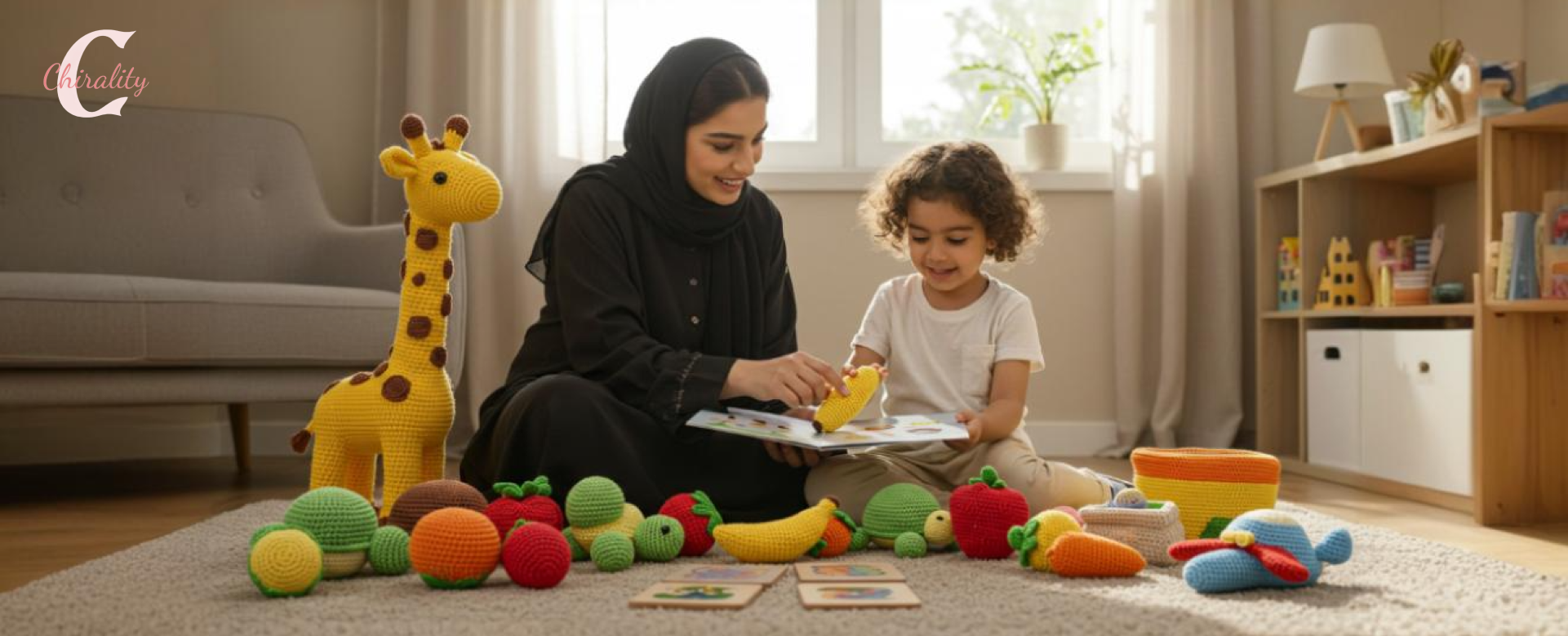
Creating interactive stories using crochet
Parents and teachers can set up a set such as a knitted farm or a small kitchen to encourage the child to build short stories using the characters, which enhances storytelling skills and linguistic imagination.
Benefits of imaginative storytelling:
NAEYC emphasizes that storytelling play enhances a child's ability to express themselves, form sentences, and remember sequences of events effectively.
How do you choose suitable educational crochet toys?
Choosing crocheted toys for children requires considering several factors to ensure the child's safety and achieve the desired educational benefit. Among the most important of these factors are:
1- Safety first:
Make sure the yarn used is natural and safe, such as organic cotton, and free of harmful chemicals. The stuffing inside the toys should also be safe and non-choking, and avoid toys with small parts that a child could swallow.
2 - Educational diversity:
Choose games that combine fun and learning, such as alphabets, numbers, animals, and different shapes. Games that offer dual functions help children develop multiple skills simultaneously.
3 - Attractive design:
Bright colors and fine details attract the child's attention and encourage him to play and explore, increasing opportunities for learning and interaction.
4 - Age suitability:
Choose toys that are appropriate for the child's age, as children's needs vary at different stages of development. Toys should be simple and safe for infants, and more complex for older children.
5 - Easy to clean:
It is preferable to choose crochet toys that can be easily washed to keep them clean and the child healthy.
Reliable and well-known sources
- International Literacy Association : On the importance of early exposure to letters to improve reading and writing skills.
- NAEYC – National Association for the Education of Young Children : Supports sensory and motor learning styles through play.
- Reach Out and Read : An organization that promotes a culture of reading aloud with children from their earliest months to achieve better language development.
- UNICEF Early Childhood Development : Highlights children's play as a key pillar for language development.
- Zero to Three and Montessori Nature : They offer tools and ideas for incorporating crochet toys into the daily educational routine.
Supporting fine motor development
The importance of fine motor skills:
- Developing hand and finger skills is essential for children, as it plays a major role in writing and drawing later on.
Choosing suitable games:
- Toys that have parts that can be grasped and moved help the child improve hand-eye coordination.
How to play:
- Encourage the child to pick up the toys, move them around, and connect them together, to effectively enhance these skills.
Conclusion
Today , crocheted toys for children are more than just beautiful knitted items; they are effective educational tools that develop a child's vocabulary through interaction and play. From Arabic or English letters to crocheted animal figures, every playtime can be transformed into a linguistic and educational opportunity that fosters a child's confidence in communication. These toys combine learning with fun and are a smart investment in children's development from a very young age.